“In the world of dynamical systems, from a mathematical standpoint, feedback loops, especially in complex systems, can be really scary. Because of their unintended consequences. They can create all the beauty and richness in the world around us as well as unforeseen horrors.”
Steven Strogatz, Professor of Applied Mathematics at Cornell University
Shame, guilt and regret are common in human societies, although today maybe less than in the 18th and 19th century. Already Charles Darwin has written about them in The expression of the emotions in man and animals. Shame arises from a violation of cultural or social values while guilt feelings originate in violations of one’s internal values.
A recent simulation from Klaus Jaffe (Complexity Vol. 14, Issue 2 (2008) 46-52) shows that shame may help individuals to avoid social punishment. In this sense shame can be considered as a adaptation to social punishment. If this is correct, then in conservative societies with strong social punishment (which impose high costs on defectors) shame should be more pronounced than in liberal societies where less social punishment is common. The western societies of the 18th and 19th century where shame was not unusual were indeed much more conservative than the societies today, the social norms and values were much stricter, and the Christian religions had more influence.
If shame is an adaptation to social punishment, then one can also take a look at the opposite: is sociableness an adaptation to social reward (and to a lesser extend proud, pride, and vanity) ?
Nearly a hundred years ago, the Titanic and the Olympic were the marvels of contemporary engineering and modern shipbuilding. They were giant swimming coal-fired power plants. Edward J. Smith, Captain of RMS Titanic, said: “I cannot imagine any condition which would cause this ship to founder. I cannot conceive of any vital disaster happening to this vessel. Modern shipbuilding has gone beyond that”. Well, we know the fate of the Titanic. Ships can sink, planes can crash, and rockets can explode. Even modern engineering is not free from disasters and catastrophes: first the Space Shuttle Challenger disaster during the start 1986, then the terrible Space Shuttle Columbia disaster during the landing, 2003.
“When anyone asks me how I can best describe my experience in nearly forty years at sea, I merely say, uneventful. Of course there have been winter gales, and storms and fog and the like. But in all my experience, I have never been in any accident… of any sort worth speaking about. I have seen but one vessel in distress in all my years at sea. I never saw a wreck and never have been wrecked nor was I ever in any predicament that threatened to end in disaster of any sort.
Edward J. Smith, 1907, Captain of RMS Titanic when it sank in 1912
“The Olympic is unsinkable, and Titanic will be the same when she is put in commission. Either of these two vessels could be cut in halves and each half would remain afloat almost indefinitely. The non-sinkable vessel has been reached in these two wonderful craft. I venture to add, that even the engines and boilers of these vessels were to fall through their bottoms, the vessels would remain afloat.”
Edward J. Smith, Captain of RMS Titanic when it sank in 1912
( The photos are from the “The Library of Congress”, they can for example be found here in the Flickr stream of The Library of Congress)
Where will the true AI which marks the next major evolutionary transition emerge? Is there already an AI lurking in the data centers of Google? Maybe it is as simple as this:
What indication of its existence might we expect from a a true AI? Scanning of all available books? Trying to access the world’s information? Well, if your company starts to build an army of indestructible robots then you might have a reason to be a bit distrustful..
Dan Dennett about consciousness, magic and illusions: if you work on one neuron, that’s neuroscience, if you work on two neurons, that’s psychology. The same talk can also be found on You Tube here .
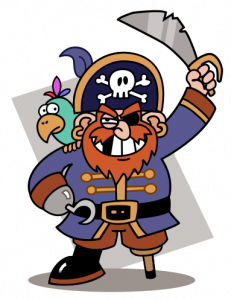
In the popular modern imagination, pirates of the classical period were rebellious, clever individuals who operated outside the restricting bureaucracy of modern life. They are surrounded by myths and legends. Yet from a modern point of view, the pirates of the 18th century were also terrorists. Piracy after all is just robbery committed at sea, without a commission from a sovereign nation. It is interesting that the golden age of pirates began after the naval wars between England, Spain and France. Many pirates who have looted ships in the name of their king before now did the same for their own sake, because the state pirates were no longer suited for the new politics. The royal empire created it’s own terrorists, just like the USA created it’s own terrorists today.
an empire or superpower first delivers weapons and
military knowledge to autonomous parties or groups in
instable regions (here a kingdom which supports pirates),
then the autonomous parties succeed in their
conflict, fight or resistance against something
(they loot the foreign ships successfully).
Times have changed and the autonomous parties
do something that is not intended by the superpower
(for instance they loot ships of the crown).
Finally the superpower turns against the autonomous
parties, threatens them or tries to eliminate them
(the king uses the royal navy to eliminate the pirates).
What have pirates and philosophers in comon? Do Plato and Blackbeard share a common passion? It is hard to believe, but the ancient Greek philosophers and the pirates of the 18th century lived both in early democracies. The economist Peter Leeson and the historian Marcus Rediker argue that pirates in this age understood the advantages of constitutional democracy. They had their own constitution which regulated the division of the loot and the election of the leader. The leader was (s)elected democratically, and the crew “voted him out” if he was autocratic or acted cowardly.
Why did democracy emerge in the city states of ancient Greece and on pirates ships of the 18th century? The Greek city states and the pirate ships were both small isolated communities. Contrary to the Greek city states surrounded by craggy mountains and the Mediterranean sea, cities in Babylonia or Persia were not isolated enough. Greek city states and pirate ships were largely isolated from foreign influence, and there was a strong sense that the city or the ship belonged to the community itself. Both communities knew the consequences of tyranny and autocratic dictatorship and were able to topple autocratic leaders quickly, because the small size of the communities limited the power of the rulers. It was easy to assemble all members of the community in no time, and hard for an autocratic ruler to escape or to hide. The small size of the population was also the reason why the members depended on each other for better or worse in both communities. In case of war, every individual was needed. Therefore they clearly needed structures and rules to organize their common life. It was hard to force the members of the communities to do something.
The conditions for the emergence of democracy are therefore:
a small community living in an isolated area (city-state or ship)
a feeling of ownership for this area among the members
a strong dependency of the free members on each other
This NASA image (Credit: NASA, ESA and J. M. Apellániz) shows some very massive stars (about 100 solar masses) in the open cluster Pismis 24. Toward the bottom of the image, stars are still forming in the associated emission nebula NGC 6357.
If you came here to look for cosmic evolution in general, you might want to take a look at this site about cosmic evolution from the Wright Center for Science Education. Eric Chaisson has also written many articles and books on this topic.




 In the popular modern imagination,
  What have pirates and philosophers in comon? Do Plato and Blackbeard share a common passion? It is hard to believe, but the ancient Greek philosophers and the pirates of the 18th century lived both in early democracies. The economist