« Older Entries Newer Entries » Subscribe to Latest Posts

26 Jul 2010

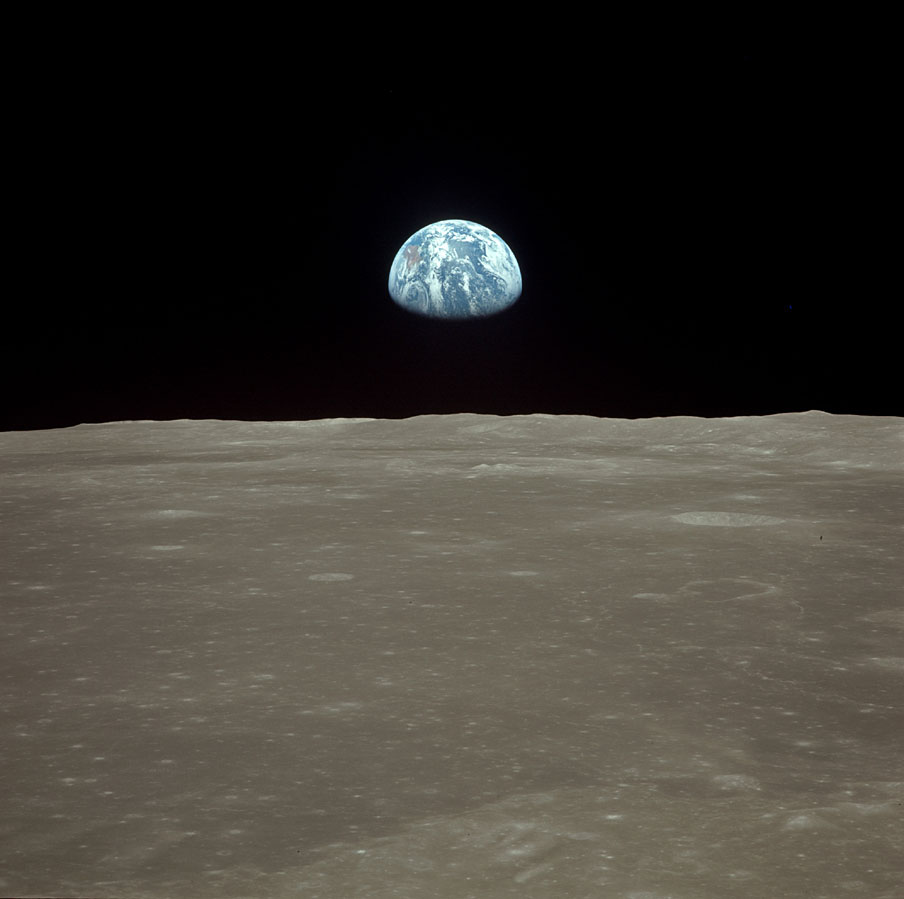
Earth emerges over lunar horizon

Posted by jofr. No Comments

It is always amazing to see the earth from space. To see sunset and sunrise from a space station is spectacular. It is even more spectacular to watch earthrise from a larger distance. Last year was the 40th anniversary of the first Apollo moon landing. The crew members of Apollo 8 were the first humans to witness the Earth rising over the Moon’s horizon. Later Apollo missions also witnessed this fascinating event. The Astronauts from Apollo 11, Armstrong, Aldrin and Collins (the first men who landed on the moon), brought back this nice sequence of pictures showing how the earth emerges and rises over the lunar horizon:

Back these days there were no digital cameras. They used analog cameras and brought back the film manually. Today we have all kind of digital devices and cameras. The best cameras are built by the Japanese. Therefore it is not surprising that the first lunar orbiter that has captured how planet earth appears over the lunar horizon in HD is from..

..JAXA (Japan Aerospace Exploration Agency) 😉

Yet it seems that we have made little progress over the last four decades. Yes, our computers and cameras have become much better, and we have color TV in HD, McDonald’s and billions of mobile phones, but we have also exploited nearly all easily accessible oil resources and polluted the last corner of our precious planet. The global population and the amount of waste (atomic or otherwise) is much too high. Look how small and fragile our small blue planet looks from a distance. It is all we got. There is nowhere else to go. Space is a vast, empty, lonely, and desolate place. If we could see the world from that distance, as those astronauts did, would we behave more responsible? Would be stop fighting each other, stop burning the rain forests, stop wasting energy and stop exploiting natural resources?

Probably not. Although Buzz Aldrin saw all the “magnificent desolation” of earth in space with his own eyes, he got problems with depression and alcohol after his moon flight. “Magnificent desolation” were the words used by Aldrin on the moon to describe the situation. Armstrong said: “Isn’t that something! Magnificent sight out here.” and Aldrin responded “magnificent desolation”. On the moon and other planets of our solar systems there is only magnificent desolation. Here on earth we have magnificent complexity. If the astronauts don’t recognize how precious our planet is, will we ever do? This is somewhat depressing. Probably nothing will fundamentally change until a really large catastrophe happens.

(all pictures are from NASA and can be found at the Project Apollo Archive)

24 Jul 2010

How a scientist sees the world

Posted by jofr. No Comments

Richard Feynman said that science does not take away the beauty of nature, whether you consider stars..

Poets say science takes away from the beauty of the stars — mere globs of gas atoms. Nothing is “mere”. I too can see the stars on a desert night, and feel them. But do I see less or more? The vastness of the heavens stretches my imagination — stuck on this carousel my little eye can catch one-million-year-old light. A vast pattern — of which I am a part… What is the pattern or the meaning or the why? It does not do harm to the mystery to know a little more about it. For far more marvelous is the truth than any artists of the past imagined it.

..or flowers:

I have a friend who’s an artist, and he sometimes takes a view which I don’t agree with. He’ll hold up a flower and say, “Look how beautiful it is,” and I’ll agree. But then he’ll say, “I, as an artist, can see how beautiful a flower is. But you, as a scientist, take it all apart and it becomes dull.” I think he’s kind of nutty. […] There are all kinds of interesting questions that come from a knowledge of science, which only adds to the excitement and mystery and awe of a flower. It only adds. I don’t understand how it subtracts.

I think he is right, although you might never again see things in quite the same way. For example once you understand how fractals work, you start to see fractal patterns everywhere. On the Abstruse Goose blog, one can find a nice picture how a scientist sees the world:

On the top left one we see Maxwell equations and the laws of gravity, in the trees the chemical equation for Photosynthesis is visible, Schrödinger equation can be seen at the horizon, in the river Navier–Stokes equations appear, and on the bottom right there is a IFS for a fractal “fern”.

If we look behind the scenes, there are many fascinating structures and processes which we can not see. The world of (Bio-)Chemistry for example contains countless complex objects, which we are only beginning to understand. While you are reading this, you might drink a cup of coffee which contains Caffeine. Did you know that Caffeine is in fact a small molecule which has a complex structure? The chemical name is trimethylxanthine. In your brain it functions as a adenosine impersonator. Chlorophyll, the green pigment found in all plants and algae which makes Photosynthesis possible, is even more complex and resembles Hemoglobin, the oxygen-transport protein in red blood cells (although it contains iron instead of magnesium ions). These complex structures are completely invisible to us, we can only recognize the effects.

The world of (Particle-) Physics contains many complex objects, too. The Standard Model of Particle Physics says that the worlds consists of many types of fermions, bosons, quarks and leptons which interact in complex ways. The following impressive chart of the CPEP describes the standard model of the fundamental particles and interactions. It is hard to believe that all these interactions and processes between tiny particles really go on behind the scenes. Science says they do..

If you think about it, it is just incredible what is going on in a single moment at a single place. On a higher level, these subatomic particles form whole galaxies of particles, the atoms themselves, which obey the Schrödinger equation and the laws of Quantum Mechanics. They also form the electromagnetic waves which are described by Maxwell equations. It is marvelous what is going on if we just say “Hello” in our mobile phone..

20 Jun 2010

Quotes from Leonardo da Vinci

Posted by jofr. No Comments

Leonardo da Vinci (1452 – 1519) was a famous Italian artist and and inventor. Besides being a painter, he was also a sculptor, architect, engineer, and scientist. In fact he had a multiplicity of interests that motivated him to pursue the edge of knowledge in many important fields, for instance medicine, architecture, and engineering. Leonardo was valued as an engineer and admired for his technological ingenuity. In his spare time he had visions of flying machines that resembled inventions of the 19th and 20th centuries.

Here are some of his quotes, first some about creativity:

Life is pretty simple: You do some stuff. Most fails. Some works. You do more of what works. If it works big, others quickly copy it. Then you do something else. The trick is doing something else.

Every now and then go away, have a little relaxation, for when you come back to your work your judgment will be surer. Go some distance away because then the work appears smaller and more of it can be taken in at a glance and a lack of harmony and proportion is more readily seen.

About truth and understanding:

Beyond a doubt truth bears the same relation to falsehood as light to darkness.

The noblest pleasure is the joy of understanding.

From his notebooks:

When you put your hand in a flowing stream, you touch the last of what has passed and the first of that which comes

He who, without Fame, burns his life to waste, leaves no more vestige of himself on earth than wind-blown smoke, or the foam upon the sea

The last quote is actually a quote itself, it is based on Dante’s, Inferno, 24:49–51: “He who, without Fame, burns his life to waste leaves no more vestige of himself on earth than wind-blown smoke, or foam upon the water”

13 Jun 2010

Complex Adaptive Systems Tag Cloud

Posted by jofr. No Comments

Tags: ,

12 May 2010

The end of civilization(s)

Posted by jofr. 1 Comment

Have you ever asked yourself why civilization and barbarism go often hand in hand? Walter Benjamin said in his “Theses on the Philosophy of History” that “There is no document of civilization which is not at the same time a document of barbarism.” Germany was the country of famous classical poets, playwrights, and theatre directors, such as Goethe, Schiller, Brecht and Tucholsky. Is is the land of famous composers like Beethoven and Bach, who laid the foundation of classical music. It is the nation of famous scientists like Carl Friedrich Gauss, Max Planck and Albert Einstein. And yet we had WWII with the Holocaust organized by Nazi Germany in Buchenwald, Dachau, Auschwitz and Treblinka. How does it fit together, the best (Goethe) and the worst (Buchenwald) of European culture? When they realized the full extend of the holocaust after the war, the Germans themselves were shocked how this could have happened.

Yet this combination of civilization and barbarism is not a new problem. Ancient China was far ahead of the time, because it was among the first cultures that used a hieroglyphic writing system. It is one of the oldest cultures in the world which was based on famous thinkers and philosophers like Confucius and Laozi. In the Qin Dynasty of ancient China, impressive projects were realized, including the first version of the Great Wall of China and the city-sized mausoleum of the first emperor Qin Shi Huang guarded by the Terracotta Army. But the first emperor also was a brutal tyrant who buried many people alive and sacrificed thousands of people. This combination of civilization and barbarism can be found in other ancient cultures as well. The Romans for example were very civilized, but also very brutal. It was not only Jesus who was crucified, crucifixion was a common death penalty in Ancient Rome. The Christian church teaches love and charity, and included famous saints like Francis of Assisi, but it also used and produced the inquisition in the Middle Ages and in Middle America. The Aztecs used hieroglyphic writings, but brought the practice of human sacrifices to an unprecedented level. We can find on the one hand highest culture in form of hieroglyphs and writing systems among nearly all Mesoamerican cultures, and yet on the other hand extreme violence and brutality.

So how do the best and the worst of a culture fit together? Let us make a list:

  • Goethe and Buchenwald in Germany
  • Cicero and Crucifixion in ancient Rome
  • Francis of Assisi and inquisition in the Christian church
  • Konfuzius and the live burial of scholars in ancient China
  • (unknown writer of) hieroglyphs and mass human sacrifice in Aztec Culture

Scholars have long puzzled over the Maya civilization’s rise to glory and fall to ruin. If you watch documentations like “Cracking the Maya Code”, you wonder how they might have lived, and what they may have thought. People back then were not that different from today, some just wanted to be peaceful scientists, artists, writers or farmers, while others were more interested in power and insisted on repulsive rituals, bloody sacrifices and endless wars. It is really puzzling why the extremes worked together so well among the Maya and the Aztecs: the smart artists, scribes and writers who wrote the hieroglyphs, and the stupid rulers who made one bloody sacrifice after another. The story behind the centuries-long decipherment of ancient Maya hieroglyphs is amazing, and so are the writers and artists who wrote them. The cruel kings and evil priests who did human sacrifices were just disgusting. How did they fit together?

Well, maybe they didn’t. And just stopped listening to each other. The first Chinese emperor no longer listened to his scholars and buried them alive, and the Aztec emperors did the same. In Nazi Germany, Hitler no longer listened to scientists and scholars as well. For members of the Nazi party a Reichsparteitag was the rise of German culture, for many intellectuals and civilized people it was the decline. In the beginning culture and power are a good combination, like marketing and technology. Language and culture enable the establishment of civilization in the first place. Rich families and powerful rulers often support art and culture by patronage. For example Leonardo da Vinci and Sando Boticelli were sponsored by the rich Medici, a banking family in the 15th century. Haydn and Mozart were sponsored by rich bishops and wealthy aristocratic families. In these patronage system, resources of the state, country or community are used to reward individuals for their outstanding achievements in art and culture, often to portrait and glorify the current rulers. The steles in many Maya cities, for instance Quiriguá, have no other purpose. Civilizations are made of powerful culture and civilized power. But culture without power is boring, power without culture is evil.

Let us make an updated version of the list where poets and saints and replaced by emperors. Now it makes more sense:

  • Goethe Hitler and Buchenwald in Germany
  • Cicero Caesar and Crucifixion in ancient Rome
  • Konfuzius Qin Shi Huang and the live burial of scholars in ancient China
  • Francis of Assisi Pope Gregory IX and inquisition in the Christian church
  • hieroglyphs Moctezuma and mass human sacrifice in Aztec Culture

A system becomes evil if its resources are used to support the regime in a doubtful way, for example by suppressing and persecuting members of the opposition. We wrote earlier about Terror as adaptation which can occur if people are threatened by an omnipresent system or superpower, which can result in the appearance of unpredictable, hidden and cruel terrorists. The opposite is a system which is threatened by the own members. If it faces legitimate charges and if it is not willing to change itself, then such an unjust system can turn into a cruel system which uses torture and tyranny. Terror can be shown from a system as well, especially if it tortures the own members to get access to secret information. Rigid, fragile and centralized systems fear the hidden terrorist, prophet or intellectual which has secret plans to topple the system. By proposing a new system to a wide audience, a single member can threatening the complete system. It is of crucial importance to the system to obtain this information, which can lead to all forms of inhuman punishment, coercive interrogation techniques, and physical torture. In this sense, torture is a responsive of an unjust, brittle and inflexible system to conspiracies and secret plans, it is an attempt to eliminate secret proposals for a new system. It is a reaction of a system which is unable to change and to adapt itself.

The reaction of a system which is unwilling to change is especially strong if it has evolved slowly into a different system in the course of time. Examples are crucifixion in Ancient Rome, inquisition in the Christian church, and human sacrifice in the Aztec Empire on a massive scale. The objective of crucifixion, inquisition, and human sacrifice was combating enemies of the system – i.e. combating heresy. The worst possible punishment reflects the worst possible threat for the system. Unjust members who use unfair means and question the system are fought by an unjust system through unfair means.

Ancient Culture Symbol Old System New System Reaction to heresy
Aztec Empire Templo Mayor religious system, religion of sacrifice military system, Aztec Empire Human Sacrifice
Christian Church St. Peter’s Basilica religious system, religion of love political system, absolute monarchy Inquisition
Roman Empire Colosseum political system, Roman Republic military system, autocratic empire Crucifixion
Ancient Chinese Empire Great Wall of China political system in form of legalism military system, autocratic empire Live Burial
Nazi Germany Hakenkreuzflagge political system in form of Weimar Republic military system, autocratic empire Concentration Camps

The original societies in Mesoamerica, for instance the Maya, were all small city states based on agriculture. Sacrifice was important for the ancient Maya, but originally the emphasis lied on the sacrifices which the rulers made themselves, for example by all kinds of blood letting rituals. When they became imperialistic systems which tried to expand their territory by military operations, human sacrifices became more frequent. The Aztec empire and many of the classical Maya city states under the influence of Teotihuacan turned into conquest states, and the temple pyramids turned from places where ancestors were worshiped and rulers made sacrifices into places of terror and human sacrifice. The Aztec ruler Ahuizotl ripped out the hearts from 20,000 captives to suppress vassal city rebellions.

The original Christian church was based on a religion of love. In the 15th and 16th century, the church had become rich and powerful, and it turned from a religious system into a political system, a kind of absolute monarchy. St. Peter’s Basilica reflects this change as it turned from a plain church into a magnificent palace, the new Basilica of the 15th century which replaced the old Constantinian basilica. The inquisition happened during this time, a time of rebellion and reformation, where many new forms of the Christian church emerged.

The original Ancient Roman was a culture based on agriculture, too. Mass crucifixions took place from 70 BC to 70 AD, when the Roman Republic turned into an autocratic Roman Empire and the Roman Senate was superseded in importance by the Colosseum. Crucifixion was used for slaves, pirates, and enemies of the state. Notorious mass crucifixions happened on a large scale during times of rebellion and insurgence: they followed the slave rebellion under Spartacus in 73-71 BC., other Roman civil wars in the 2nd and 1st centuries BC, and the destruction of Jerusalem in 70 AD. To frighten other slaves from revolting, 6,000 of Spartacus’ men were crucified.

In ancient China during the Qin Dynasty we can find another form of inhuman torture, which was also used in Ancient Rome. People were buried alive on a massive scale. Books were burnt and scholars were buried in order to to unify all thoughts and political opinions and to suppress the intellectual discourse. This happened while the Qin Dynasty turned from a political system in form of legalism during the time of independent warring states into a imperialistic military system and an autocratic empire.

Now we can try to answer the question from the beginning why civilization and barbarism go sometimes hand in hand. It can happen at the beginning and the end of an empire or civilization, when culture and power collide, and power prevails. There are two conditions: (1) a system where this occurs must be in a transition, it may have made the transition from a civilized kingdom or monarchy into an increasingly autocratic empire, where an autocrat acts as a despot, tyrant and dictator. Roman civilization shifted from a monarchy to an oligarchic republic to an increasingly autocratic empire, the Christian church shifted from a religion of love to an oligarchic pope system with autocratic traits, the Mesoamerican civilizations shifted from Mayan city states into an increasingly autocratic Aztec empire, and the Chinese civilization shifted from a collection of kingdoms with a legal, political system into an increasingly autocratic Chinese empire. All these systems are marked by a lack of authority and mutual understanding between those at the top and those at the bottom of the system. A real autocrat is only interested in power and has lost contact to culture. And (2) the system must be questioned in a time of insurgence and rebellion.

Therefore inhuman torture and terror is not only a reaction of an evil and unjust system which is unable to change and to adapt itself. It seems to be a reaction of a system which fears the own ancestry. It has come to a branching point in evolution, where it has changed so much that it can not go back, and at the same time it can not completely loose one’s hold on the origin, either. It has changed so much that it starts to contradict itself, which opens a niche for its own ancestors. The most vulnerable points of such systems are perhaps the own roots: a system is threatened in its existence if it is challenged by its own ancestor, i.e. by a new system which is similar to the original system it has evolved from. To attack the roots means to tackle the fundamental principles of the system. If you criticize or touch the “holy” things of the system – which means the basic rules, customs, or symbols of the community – then you incur the wrath of it. The more unjust the system, the larger the wrath. The wrath of the system can reveal itself in the violation of the privacy and integrity of the individual. This works in the other direction as well: if an “evil” system touches the holy things of the individual (for instance privacy, freedom and physical integrity), then it may incur the wrath of the particular person, see Terror as adaptation.

In its extreme form, the rebellion threatens the existence of the whole system. Then the existence of the system is opposed to the existence of the individual, and vice versa. It seems as if a system becomes especially brutal if its very existence in threatened, and if it knows that its existence is questionable (the church by heretics in the Middle Ages which lead to inquisition, the Romans by insurgents which lead to crucifixion, the Nazis in WWII..) The concentration camps of the Nazis turned into real death factories when the existence of the Nazi regime was threatened towards the end of the war. Maybe this is the reason why the Aztecs – who were even worse than the Maya when it comes to human sacrifices – had a high culture and yet drowned in all the blood: because a small number of tyrannic rulers knew their existence was questionable and threatened. The Aztecs did not invent hieroglyphic writing systems and elaborate temples, they only imitated earlier cultures.

According to some sources, the Aztec emperors and the first Chinese emperor burnt like the Nazis many existing books claiming that they contained lies, and rewrote their own history. Burning books and burying scholars means to suppress all intellectual discourse. In a military system, it is good to suppress all intellectual discourse and to unify all thoughts and opinions. In a cultural system, it is bad and disastrous to suppress the intellectual discourse to unify all thoughts and political opinions. Book burning is a certain sign of culture in decline. It happens in a civilization where power prevails over culture. The first Chinese emperor and the Aztec emperors inherited a rich culture and made it wrong. Civilization(s) can come to an end when government goes awry. At the beginning and the end of an empire, civilization and barbarism go often hand in hand.

The civilized individual shares all the benefits of a large civilization, but it also shares the negative consequences, including toil, sweat and labor. The assets and drawbacks are not always fair or equally distributed, especially if the civilization is a transition point: in the beginning, at the end or in a crisis. Maybe this is what Walter Benjamin meant in his “Theses on the Philosophy of History”, where he argues that the history of civilization is a history of oppression.

For without exception the cultural treasures [..] have an origin which he cannot contemplate without horror. They owe their existence not only to the efforts of the great minds and talents who have created them, but also to the anonymous toil of their contemporaries. There is no document of civilization which is not at the same time a document of barbarism.

(The Photos are public domain photos from Wikipedia. They show the Reichsparteitag and the Aztec codex Magliabechiano)

8 May 2010

Virtual Worlds and Subjective Experience

Posted by jofr. 2 Comments

Above you can see the dining room of Christ Church, Oxford. Christ Church was founded in 1546, it is one of the largest and oldest colleges in the University of Oxford. Like many other Oxford locations, the dining hall appears in J.K Rowling’s Harry Potter films, in the Harry Potter world it is the Hogwarts dining hall, where for example the sorting ceremony takes place. Oxford is the place where J.R. Tolkien worked at various colleges, too. As a professor of English literature, he was mainly interested in all kind of languages, and he liked to invent his own ones. During his career, he was at various colleges in Oxford, including Exeter College, Pembroke College and Merton College.

J.K. Rowling and J.R.R. Tolkien created both new worlds. Both loved writing, and believed in their visions and passions. Both had in common that they had not the goal of becoming famous. They just wanted to tell a wonderful story. Rowling created the imaginary Harry Potter fantasy world, Tolkien created the fictional world of Middle-earth which is described in his monumental LoTR work “Lord of the Rings”. Tolkien can be considered as the inventor of the fantasy genre in general. He invented his world to create a world where his fictional languages for elves, dwarves and orks would fit in. Rowling invented a fictional pseudo language similar to Latin for her wizards and witches, too. Today, there are many more fantasy worlds that are not Potter or LoTR. George Lucas invented the Star Wars universe, Gene Roddenberry the imaginary Star trek world. There are also more and more virtual worlds, MOGs, and MMORPGs. The biggest MMORPGs are EVE Online and WoW. Star Trek is available as a massively multiplayer online game, too, it is named Star Trek Online. Star Wars is available as a MMORPG named Star Wars Galaxies. There are many fantasy action MMORPGs, for instance Aion, Final Fantasy, or TERA Online, and classic MMORPGS like Heroes of Might and Magic Online and Dungeons and Dragons Online.

It all began with Tolkien. His fantastic work is a true masterpiece. Most of us will not create such masterpieces, but we all have the opportunity to create ordinary children, as Lee Ann Womack describes in her song “Something Worth Leaving Behind”:

I’ll probably never hold a brush
that paints a masterpiece
Probably never find a pen
that writes a symphony
But if I will love then I will find
That I have touched another life
And that’s something
Something worth leaving behind

Perhaps we all have the drive to create something worth leaving behind. Something which reminds future generations that we have been here. Creative activities like writing, painting, and composing are indeed very personal, they transform subjective experience in objective reality. They turn the inside out literally, i.e. they take the inside to the outside. While Psychologists and Philosophers wonder endlessly if inner experience can ever be accurately described, because it is always subjective and private, and introspection is unreliable, unverifiable and controversial, countless composers, artists, and authors (like the Russian authors Tolstoi, Dostoevsky and Chekhov) and have done for centuries just this: they have described their inner experience with skillful notes, brush strokes, or words, and transfered their inner experience into an elaborate desription of an imaginary sequence of events.

The creative person combines and links the various personal impressions, memories and experiences into a consistent whole, which is sometimes a detailed reproduction of the past, and sometimes something completely new. Anton Chekhov for example combined his experience he made as a doctor with his impressions of the Russian landscape (especially the Volga) and his knowledge of the contemporary Russian society. Like nearly all authors, he wrote about himself, and his short stories are condensed descriptions of his personal experiences. Tolkien combined his deep knowledge of nordic mythology and ancient languages with his personal experiences in the first world war. Tolkien and Rowling both went beyond a mere description of personal experience, they managed to invent a whole new imaginary world. This creative activity is the opposite of normal perception, which transforms objective reality in subjective experience.

  • Author, Artist, Composer: subjective experience is turned into objective reality.
    Description and combination of subjective experience leads to the creation and construction of stories, works of art, and virtual worlds
  • Consumer: objective reality is turned into subjective experience.
    Continued selected perception of the real world in it’s various forms and flavors leads to subjective experience

In this sense, personal creativity and subjective experience are two sides of the same coin. Both are very personal and subjective processes. Subjective experience, especially the subjective quality of conscious experience, is a popular problem in the Philosophy of mind. It depends on the personal emotions. It is the personal experience of an individual person, which is different for everybody because people live in different worlds (in the words of Nicholas Thompson in different “slices” of the same world).

“The peculiarity of our experiences, that they not only are, but are known, which their ‘conscious’ quality is invoked to explain, is better explained by their relations – these relations themselves being experiences – to one another.” – William James

Subjective experience seems to depend on individual memories: each perception is linked to similar perceptions one has experienced before. Since every person has a slightly different history resulting in different memories and experiences, each person has a unique, individual subjective experience, dependent on his individual slice of the world.

7 May 2010

Have a break

Posted by jofr. No Comments

Are you working like a machine? You owe it to yourself to take a break..

..or a cold beer. Cheers!

Tags: , ,

3 Apr 2010

Emotions as Adaptation

Posted by jofr. 6 Comments

Emotions are not only feelings which color our life. The appraisal function is only one side, the other side is an action tendency which prepares the body for action. Nico H. Frijda defines emotions in the following way: “Emotions are changes in readiness for action” (Frijda, 1986). He argued

“Action readiness change is the major feature of emotion; it is [..] the defining feature. The notion of ‘action readiness’ includes action tendencies and activation modes; it also includes their absence, in relational null states and deactivations. [..] Emotional experience largely consists of experienced action readiness or unreadiness: impulse to flee or strike or embrace, lack of impulse, apathy, listlessness”

They are in fact the basic control mechanism which guides the behavior of all animals, from mice to humans. There is no introductory pyschology book without a chapter on emotions. Emotions are central to our existence and accompany almost all the significant events in our lives, for example we feel proud when we receive a promotion, we become angry when we learn that we have been betrayed, we feel joy when our children have been born, and we experience grief and sadness when someone we love has died (Smith and Lazarus, 1990). Both positive and negative emotions are indeed necessary to survive. The former tell us to do the right thing (do-more-of-it), the latter protect us from doing the wrong thing (do-less-of-it).

Neural networks and their modulation through emotions are an adaptation to motile and mobile life-forms in general, which are able to move around in complex habitats and environments. Emotion and motivation are derived from lat. movere (which means ‘move’). Plants do not have nervous systems or brains. Only animals have brains, and they need emotions as the basic connection between body and mind. Emotions advise the organism to do the right things in fast changing, challenging surroundings. In the struggle to survive, emotions have an important and essential function. Certain person-environment relationships, constellations and situations trigger instantly certain states of mind, which are characterized by a certain type of action readiness, urge or impulse to do something.

Emotions control the movements and actions of the body. Without any emotions, the organism would not know what to do and what to learn. What is important and should be remembered? What is less important and should be forgotten? Emotions answer these questions. They are a bit like the voice of the genes or a built-in navigation system for the body: the genes set the goals, and the emotions tell the vehicle where to go. They enable the organism to get away from threats to its well-being while pursuing beneficial things and useful opportunities. While basic emotions are necessary to survive at all, highly differentiated emotions are an adaptation to living conditions which require a high degree of response flexibility, for example in complex social systems. The high diversity of individual emotions, both negative and positive, help the organism to respond quickly to various threats and opportunities. Self-conscious emotions like embarrassment, guilt, pride and shame occur mainly in social groups with self-conscious life-forms such as primates and humans. They must have an adaptive advantage for the survival in these groups.

Core Relational Themes

Nico Frijda distinguishes various forms of emotions in terms of distinctly different forms of action readiness (Frijda, 1986). The following table of relational action tendencies contains elementary action tendencies and activation modes which have a particular relational aim (he uses “permitting consummatory activity” instead of proximity) :

Action tendency End state Function Emotion
1. Approach Access Producing Proximity Desire
2. Avoidance Own inaccessibility Protection Fear
3. Being-with Contact, interaction Proximity Enjoyment, Confidence
4. Attending (opening) Identification Orientation Interest
5. Rejecting (closing) Removal of object Protection Disgust
6. Nonattenting No information or contact Selection Indifference
7. Agonistic Removal of obstruction Regaining control Anger
8. Interrupting Reorientation Reorientation Shock, surprise
9. Dominating Retained control Generalized control Arrogance
10. Submitting Deflected pressure Secondary control Humility, resignation
11. Deactivation (Recuperation?) Sorrow
12. Bound activation Action tendency’s end state Aim achievement Effort
13. Excitement Readiness Excitement
14. Free activation Generalized readiness Joy
15. Inactivity Recuperation Contentment
16. Inhibition Absence of response Caution Anxiety
17. Surrender Activation decrease? Activation decrease or social cohesion? (Laughter, weeping)


According to Frijda, ‘approach’ and ‘avoidance’ include all aims which establish and decrease interaction, ‘being-with’ refers to “occasion for sustained interaction – that which is sought in approach and left in avoidance”, and agonistic means active, it is the tendency to remove obstruction.

Richard S. Lazarus, who was Psychology professor at the University of California, Berkeley, explores the relation between emotions and adaptation in detail in his book “Emotion and Adaptation” (Lazarus, 1991) and in a chapter of Pervin’s book “Handbook of Personality” (Smith and Lazarus, 1990). Lazarus distinguishes roughly 15 between distinct emotions for which he identifies ‘core relational themes’. He argues that specific emotions are aroused if an individual perceives a particular person-environment relationship which matches one of several ‘core relational themes’ for itself. The relationship which is encoded in the ‘core relational theme’ are relationships which affect (i.e. support or impair) the well-being and welfare of an individual. In this sense specific emotions are an adaptation to certain reoccuring person-environment encounters, survival relevant conditions and situations of critical importance. This response to a core-relational theme is counteractive if the appraisal is negative, or supportive if it is positive.

Emotion Core relational theme
Anger a demeaning offense against me and mine
Anxiety facing uncertain, existential threat
Fright facing an immediate, concrete, and overwhelming physical danger
Guilt having transgressed a moral imperative
Shame having failed to live up to an ego-ideal
Sadness having experienced an irrevocable loss
Envy wanting what someone else has
Jealousy resenting a third party for loss or threat to another’s affection
Disgust taking in or being too close to an indigestible object or idea
Happiness making reasonable progress toward to realization of a goal
Pride enhancement of one’s ego-identity by taking credit for a valued object or achievement, either our own or that of someone or group with whom we identify
Relief a distressing goal-incongruent condition that has changed for the better or gone away
Hope fearing the worst but yearning for the better
Love desiring or participating in affection, usually but not necessarily reciprocated
Compassion   being moved by another’s suffering and wanting to help


He emphasizes negative emotions. They are perhaps a bit more interesting, because their purpose is harder to understand at first than those of positive emotions, who make life worth living. Perhaps they are also more diverse, while there is only one main reason for positive emotions and pleasure – perfect congruence and agreement between goals – there are many forms of disagreement and incongruence. If we consider the opposites for relief, happiness, pain/anxiety, sadness, and disgust one could add the following relational themes:

Stress a distressing goal-incongruent condition has occurred
Depression making no progress at all toward to realization of a goal
Pain impeded action, existence of existential threats
Gratitude having experienced an important assistance
Joy unimpeded action, absence of existential threats
Happiness having experienced an unexpected benefit
Appetite or Curiosity   taking in or being close to a digestible object or idea


Lazarus argues further that three basic factors or components are useful to understand the relationship and interdependencies between the various types and forms of emotions: goal relevance, goal congruence, and type of ego-involvement. He prefers to use the term “ego-identity” instead of “self”.

Goal Relevance: Excitement

The first component “goal relevance” is a necessary condition for emotions. He argues that all emotions are only possible if the situation is relevant to the personal goals of the individual. All behavior is motivated by some goal, intention, or drive. Without relevance to personal goals there is no motivation, and without motivation there is no activity. The basic emotion is excitement and arousal, the organism only cares about something if there is some kind of goal relevance for it. Nobody cares if a sack of rice has fallen over in China, but if the sack of rice would belong to you and would be the only thing you have got, you would react with very strong emotions if someone tries to topple or steal it.

The rule is simple: if there is goal relevance, then there is excitement. We chose our goals because they prevent harm or generate benefit for us. Therefore “anything that implies harm or benefit to the person can produce an emotion” (Smith and Lazarus, 1990).

Goal Congruence: DO IT, DON’T DO IT

The second component “goal congruence” decides if the excitement is pleasant (positive) or unpleasant (negative), which depends on goal congruence. If there is goal congruence (basically between the current goals of the phenotype and the goals of the genotype), then positive emotions happen. If there is goal incongruence, then negative emotions take place. Primary emotions tell an organism what to do in critical situations. They reward or punish the brain for doing the right or the wrong thing, respectively:

  • pleasure, joy: do it, genes say GO
  • distress, pain: don’t do it, genes say NO-GO

Already Cicero and Epicurus have noticed this

“every animal, as soon as it is born, seeks for pleasure, and delights in it [..], while it recoils from pain [..], and so far as possible avoids it [..] every pleasure is to be welcomed and every pain avoided. (from “De Finibus, Bonorum et Malorum”, written by Marcus Tullius Cicero in the first century)”

Negative emotions have a protective function, they prevent and impede actions which would lead to harm or damage. Positive emotions have a supportive function, they encourage actions that lead to achievement of goals which are in agreement with the goals of the genes. They help an organism in making progress toward the realization of its goals. Positive emotions are an adaptation to favorable person-environment relationships, negative emotions are an adaptation to unfavorable ones. The former allow the organism to exploit favorable situations, while the latter urge to avoid unfavorable ones.

Genes give their GO or green light for everything which is in agreement with their primary goals and their basic policies: self-maintenance (which implies survival and growth) and self-reproduction.

Goal Congruence: expect x, pursue/seek x, follow x, avoid x

Secondary emotions tell an organism how to behave in complex environments. “Do it” and “Don’t do it” commands are broken down into various cases of dangerous things that should be avoided or pursued:

  • Disgust/Distaste – do not take in indigestible objects,
    don’t eat x (prevent internal harm and poisoning)
  • Fear/Anxiety – do not come close to dangerous objects,
    keep away from x (prevent external physical harm)
  • Appetite/Taste – take in digestible objects, eat x
  • Interest/Hope – come close to beneficial objects, pursue x,
    sustain commitment to x

Stress and relief select the right level of readiness for action in general. Stress is useful for preparation, relief for recuperation:

  • Excitement/Stress – prepare for x, expect x, preparation
  • Contentment/Relief – relax, don’t expect x, recuperation

While love, hope and happiness serve to engage in promising commitments with good future expectancy, sadness serves to disengage from lost commitments with bad future expectancy (Smith and Lazarus, 1990). In arises in situations where someone experiences an irrevocable loss.

  • Love/Happiness : congruence between own goals and goals of other person, meet x, follow x, engage with x, keep close to x, make progress toward the realization of a goal
  • Hate : incongruence between own goals and goals of group member,
    expel x, break relationship with x
  • Depression/Sadness – disengage from x, break commitment to x, prevent pursuit of unachievable goals, get help and support from group

Ego-Involvement: x does y to z

Complex emotions have a social component or some form of ego-involvement, they include anger, embarrassment, guilt, pride, shame. They have strong influences and consequences on the physical health and the well-being of the individual in the group. Which emotion is created by which social actions and behavior patterns depends on various factors, accountability (where is the source? who is to blame? who is accountable for it?) and effect (where is the target/victim? who is injured or damaged by it?)

Anger arises if there are obstacles. This obstacles can be social, too, for instance if important personal goals are being threatened by unfair social behavior (which is often not directly visible or hidden), and the affected person tends to blame someone else for this offense. It expresses the belief that you should be treated better and someone else is to blame for the offense against yourself. Therefore it serves to bring unfair social behavior to light, to eliminate socially demeaning offenses, and to eliminate harm which can be blamed on someone else.

While pride expresses belief that yourself should be praised for good social behavior, because you have done better than expected or required, guilt and shame are the opposite, they express the belief that yourself should not be praised for your own social behavior. If the victim is someone else, guilt arises, if the target is yourself, shame and embarrassment appear.

Contempt arise if there is a strong incongruence between the own goals and the goals of foreign person. The opposite is awe/respect: congruence between own goals and goals of foreign person

Negative emotions with Ego-Involvement
Objective Source of harm, Accountability Target, Injury
Anger eliminate source of harm by FIGHT, reveal unfair behavior, demeaning treatment or inadequate social actions other self
Fear, Anxiety eliminate source of harm by FLIGHT, avoid potential harm, hide self other self
Shame, embarrasment hide embarrasing behavior, live up to ego-ideal self self
Guilt correct unfair social behavior, make reparation for harm to others, prevent loss of favor self other
Contempt don’t imitate x, don’t meet x, don’t learn from x other other
 
Positive emotions with Ego-Involvement
Objective Source of support Target
Pride take credit for achievement, show enhanced ego-identity self self
Gratitude prevent loss of favor other self
Awe imitate x, meet x, learn from x other other

Conclusion

The high diversity of individual emotions, both negative and positive, help the organism to respond quickly to various threats and opportunities. If an organism has a variety of differentiated emotions, it has the adaptive advantage of protection from various sources of harm and danger (fear and anxiety protect from dangerous predators, disgust protects from the risk of poisoning and infectious disease, pain protects from damaging the physical integrity, sadness motivates us to seek aid and comfort while coming to terms with out loss, depression protects from pursuing unachievable goals, stress protects in threatening situations with high risk of severe attacks). It also benefits from the support of “advisers” and “consultants” who optimize progress toward basic goal achievement (joy and pride encourage sustained commitment to beneficial goals, relief saves energy and resources, attraction to food and mates secures self-maintenance, self-conservation and self-reproduction, ..).

Emotions are an adaptation of animals to fast changing and challenging contingencies in their environment. The environment of an animal can change suddenly from peaceful and friendly to hostile and harmful. For social animals, especially humans and primates, the environment consists mainly of other animals, which can interact in various ways. In this context it is beneficial when certain agent-environment relationships, constellations and situations trigger instantly certain states of mind, which are characterized by a certain type of action readiness, urge or impulse to do something. Emotions influence strongly how agent and environment interact with each other. In this sense, they characterize different relationship changes between the goals of an agent and the environment. The various types and forms of emotions can be understood in terms of goal relevance, goal congruence, and type of ego-involvement.

Bibliography:

Nico H. Frijda, The Emotions
Cambridge University Press, 1986

Richard S. Lazarus, Emotion and Adaptation
Oxford University Press, 1991

Craig A. Smith and Richard S. Lazarus
“Emotion and Adaptation” in Lawrence A. Pervin (Ed.)
“Handbook of Personality”, The Guilford Press, 1990

13 Feb 2010

Fraud as Adaptation

Posted by jofr. 2 Comments

Truth is so obscure in these times, and falsehood so established, that, unless we love the truth, we cannot know it.
-Blaise Pascal

A recent article in “The Economist” named Fraud in science confirms that fraud and fabricated results are not rare in science. Only in rare cases the public becomes aware of it, when the claims become too spectacular. Scientists are not quite as honest as might be hoped. Scientists are just as human as everyone else. But it science, it is a problem to be human: it is a severe sin to lie or to fabricate data in science, because it steers people down path that do not lead anywhere.

There is a certain kind of scientist who is a master when it comes to fraud and imposture. He creates confusion instead of understanding. He is someone who invents problems instead of solutions, who conceals the truth instead of revealing it, who complicates things instead of simplifying them. His vague papers are full of complicated words or equations, although he has found out nothing. You might call him cheater, impostor, bluffer, or swindler (in German “Schwindler”).

Some scientists explain the most complicated things in very simple words. Other scientists explain the most simple things in very complicated words. At the end of this scale, you can find the extremes: the genius and the impostor. The genius explains everything with nearly nothing, the impostor explains nothing by making everything unclear.

The scientific impostor acts like a magician. He confuses the audience. He pretends to be able to do something, and he hides perfectly that he is not able to do it. He works with illusions. He creates a kind of “reality distortion field”. There is only one science where it is legitimate to distort reality: Marketing. Marketing is an exception. Here you have to distort reality to convince customers to buy a product. In all other sciences, scientists learn to tell the truth. They should support understanding, not impede it.

Scientific impostors hide themselves behind complicated

  • word-monsters in Sociology and Philosophy
  • formulas and equations in Physics and Mathematics
  • frameworks and formalisms in Computer science and Engineering

All they really do is inventing acronyms and buzzwords. This is where they good at. They are acronym finders and buzzword specialists. They know when and where you have to use what buzzword to achieve a maximal effect. They know what kind of buzzwords are out of date. They know how to produce something which looks real, although it is unreal and fabricated. They are good in bluffing, in acting, and in pretending.

There are many impostors and air merchants at the universities. In German you call them “Schwindler” or “Schaumschläger”. All they do is producing hot air and inventing new buzzwords. They are a bit like intelligent bots (ELIZA etc.), which never will achieve real intelligence, they only produce a perfect illusion of intelligence. Likewise, Schaumschläger will never produce any real progress to science, only a perfect illusion of progress. They are good in selling themselves, in getting jobs and grants, and in pretending to be important. Apparently you can not get a grant or a job as a professor if you admit that it is impossible to find out something new. But if you pretend that you can, and if you are good in self-marketing, you might be successful. This is the reason why impostors are very common in areas where it is very hard to find out anything new, for example in theoretical physics or distributed systems (which belong to the most difficult fields in Physics and Computer Science, respectively). In a sense, they are an adaptation to fields where it is nearly impossible to find out new things. Fraud is an adaptation to domains where it is impossible to achieve a goal with honesty and truth. The cheater has it much easier than the honest man to reach an unachievable goal. In general, imposture, fraud and lies are adaptations to situations where honesty and truth will hardly lead to a success.

31 Jan 2010

Underground Economy as Adaptation

Posted by jofr. No Comments

Wikipedia says that underground economy refers to “both legal activities, such as often found in construction and services industries where taxes are not withheld and paid, and illegal activities, such as drug dealing and prostitution”. Like corruption and terror, it can be considered as a form of adaptation, too. We have argued earlier that terror is an adaptation to the tyranny of selfish global superpowers, while corruption is an adaptation to institutional weakness. In Afghanistan we have both: terror and corruption. And an active underground economy based on opium production.

An underground economy is an adaptation to a weak economy, to a place at the edge of economy where it starts to fail. Underground economy – including black markets, prostitution and drug dealing – is an adaptation to failure of the economy to cover basic needs of the population. It comes into play if there is a strong demand for a certain good, but no official or legal supplier.

An underground economy can be the result or unintended consequence of a prohibition or ban. In this case, the demand growths endlessly, while the supply is officially zero. The prohibition of alcohol in the United States is an example. Prostitution and drug dealing are two examples where there is a never ending demand. They reflect people’s basic need for sex and drugs.

Drug dealing is an area which is not well covered by the global economy. It does not allow the production of drugs, and it prohibits their trade for good reasons. There would be even a bigger problem if more people could afford to buy drugs. It is not uncommon for children of stars and rich people to have a drug problem. The main consumers can be found where the economy is strong – among the winners of capitalism, the rich people. The main producers can be found where the economy is weak – among the losers of capitalism, the poor people. A successful drug market can of course turn the drug consumers into poor losers, and the drug producers into rich winners. However, all this takes place at the edge of society and economy.

The result is the emergence of an underground economy to service the rich where the global economy is really weak: in places like Afghanistan. In this poorly developed region, the drug market is nearly the only source of economic growth. It is one of the few sources of economic activity and prosperity in an otherwise barren wilderness. And it is the source of many other problems, because it is also a major source of funding for the Taliban and local drug lords. The modern Taliban act like a private army for a kind of drug cartel. In a shadow economy, cartels take the place of organizations and companies. Afghanistan is poor, there are no resources, no attractions for tourists, no possibilities to escape poverty – except drugs. Penalties for possession, use, production or trade of illegal drugs are low in Afghanistan. Even if they were higher, the state and the police are weak. The government does not even manage to get rid of the opium fields. Therefore the drug market is a key problem in Afghanistan. There will be no peace until this problem is solved. It is a global problem which cannot be solved because the origin lies deep in the western culture itself: the demand for drugs among the rich and famous. Even if the drug market is completely banned from Afghanistan, it will pop up in another poorly developed country – for instance Yemen or Somalia.

(The cocaine picture is from Wikipedia)

Update (Mar. 2010): A recent TIME article named Afghanistan’s Fix confirms the ideas in this post. It claims that some southwestern Afghan regions have the world’s highest concentration of opium production, and argues that the opium trade is deeply woven into the fabric of the (underground) economy of southern Afghanistan. Opium is the economic mainstay for many regions in Afghanistan, providing a livelihood for thousands of families, the drug lords, and the Taliban. The whole economy is based on opium production. It is organized by the drug syndicates, which are protected by the Taliban, and supplied by nearly 70,000 farmers and their families. Last year the Taliban reaped nearly $300 million from the drug trade. Where else can you earn millions of dollars in this barren country where there is nothing but dust, rubble and meager mountains. Destroy the poppy fields, and suddenly the whole country is against you, because you have destroyed the main source of income for everyone: all the local farmers, the drug lords and the Taliban. They all depend on the poppy fields, and all of them would be unemployed and jobless without them. There is no easy solution for this problem.