6
Sep
2008
Posted by jofr. No Comments
Jordan B. Pollack is a professor of computer science at Brandeis University. His interesting work falls in the field of ALife, neural networks, and evolutionary systems. He says about the core problem of AI:
“Sentient life forms are several orders of magnitude more complex than the most complicated systems designed and built by humans: Our Software. Building software using best engineering practices always bogs down between ten and one hundred million lines of code, before it becomes unmanageable by human corporations. Assume that a sentient animal mind would take tens of billions of lines of code, just like bodies are made of tens of billions of living cells cooperating to form a whole. In order to understand how nature could design systems of far greater complexity than human engineers, we must focus not on simulating human cognitive faculties, nor on trying to understand the brain, but on the process which can design such minds and brains.”
31
Aug
2008
Posted by jofr. No Comments
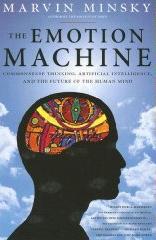 Twenty years we have been waiting for a Society of Mind II. The waiting time is finally over: in his book with the title “the emotion machine“, Minsky tries again to explain how the mind works. A good book with interesting ideas, but unfortunately also a bit disappointing: emotions are certainly important, but they are not the thing which makes humans special. Isn’t every animal an emotion machine? Every animal does not only feel the own state of the body through emotions, it is also controlled by emotions. There is one thing only humans have: humor and laughter. Yet there is nothing about computational humor in this book. Nothing about the “metaphors we live by”, either.
The most interesting idea is perhaps to introduce the “critics”. Minsky proposes a “critic-selector” model of the mind, where a number of critics evaluate situations to activate certain selectors, which in turn activate or deactivate clouds of agents. The modulation idea is not bad, although it is not very new or original. Yet critics are a good cue: imagine for example a cartesian theater, where not a single self is sitting in the audience, rather the representatives of the body, like the members of a jury (the physiological counterpart maybe the limbic system and the brainstem). On stage there are agents which represent the current state of the world. The critics in the jury now evaluate every situation, and are able to choose between thumbs up and thumbs down. If they say “Yes, I want to see it again”, then the agents on the stage are likely to appear again, if they say “No, I don’t want to see it”. A nice picture: if a person falls in love, then the critics for love always want to see the same persons on the stage..
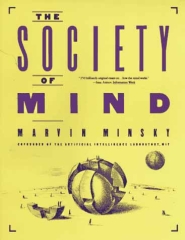 A book about emotions should examine the basic emotions, especially joy and pain. And from a successor of the popular “the society of mind” we have expected more. In his bestselling book the “Society of Mind“, he has argued that the mind can be described as the interaction of a diverse variety of mindless agents (which he calls resources in his new book). The society of Mind is certainly a wonderful metaphor and a very appealing model, if we we want to understand the process of thinking in all its intricacy. Is there a president somewhere? What happens when agents agree or disagree? See also our wiki page here.
30
Aug
2008
Posted by jofr. No Comments
29
Aug
2008
Posted by jofr. No Comments
This is the beginning of a new blog: the first post of a fresh, new blog. As Hermann Hesse said in his poem “steps” (“stufen”): “a magic dwells in each beginning” (“jedem Anfang wohnt ein Zauber inne”). In the beginning there is indeed some kind of magic: the first post in a blog, the first registration in a new community, the first page in a book.
This blog is supposed to replace the old blog of the CAS-Group , together with a set of other sites and a community (or social network) which is going to be written first. As the name says, the topics revolve around complex adaptive systems – this includes complex systems, complexity, multi-agent systems, agent-based models and swarm-intelligence. Occasionally there will be some posts about new forms of AI, new kinds of science, and new forms of technology as well.