16 Sep 2008
Brandenburg Concerto Nr. 4, third movement, prest
It would be more interesting with real music notes:
Complex Adaptive Systems Group
16 Sep 2008
It would be more interesting with real music notes:
16 Sep 2008
 Richard Conniff, who has a blog named strange behaviors, compares in his delightful book „The Natural History of the Rich“ the behavior of the rich with various animal species. Territoriality, social hierarchy, pecking orders, imitation and competition for mates are not just confined to the animal kingdom. He compares gibbons and gorillas to CEOs and movie stars, which is entertaining, but in the end they are not that different from the rest of the society, they are only more extreme and less constrained. He talks about “triple-A” personalities – people who are aggressive, acquisitive and ambitious about getting what they want. Other words starting with “a” may also come to mind – for instance arrogant.
Arrogance is a way to separate yourself from the rest. In fact this is what rich people do: separating themselves from the poor. It is an adaptive behavior. The environment of rich people is importunate and intrusive, and everyone would like to have a part of the wealth. Arrogance looks like an adaptation to this environment, a reaction to keep the intrusive people out. Quite the contrary to this nasty atmosphere, the environment of poor people is indifferent and unconcerned. Nobody would like to have contact to the have-nots. Kindness looks like an adaptation here, too. Altruism, kindness and friendliness can draw the attention of the unconcerned environment to oneself and thus compensate the lack of resources (if rich people act altruistic, it is not only to act friendly. Conniff argues that even altruism can be a way of showing wealth).
14 Sep 2008
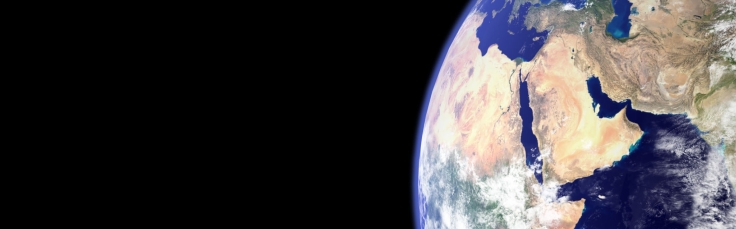
View of Hurricane Ike from the International Space Station ISS, (c) NASA

13 Sep 2008
Brian Greene writes in a NYTimes.com article:
…children begin life as uninhibited, unabashed explorers of the unknown. From the time we can walk and talk, we want to know what things are and how they work — we begin life as little scientists. But most of us quickly lose our intrinsic scientific passion. And it’s a profound loss.
Nice words. Even if you can doubt if his work on string theory is science, he is right here. All children are naturally inquisitive – they like to find things out, just as scientists and other geniuses. Arthur Schopenhauer said: Every child is in a way a genius; and every genius is in a way a child. In fact, we all like to find things out. It is sad that we lose our intrinsic scientific passion when we grow up..
13 Sep 2008
SOCIALISM: You have two cows. The government takes them and puts them in a barn with everyone else’s cows. You have to take care of all of the cows. The government gives you as much milk as you need.
BUREAUCRACY: You have two cows. At first the government regulates what you can feed them and when you can milk them. Then it pays you not to milk them. Then it takes both, shoots one, milks the other and pours the milk down the drain. Then it requires you to fill out forms accounting for the missing cows.
from Politics explained
12 Sep 2008
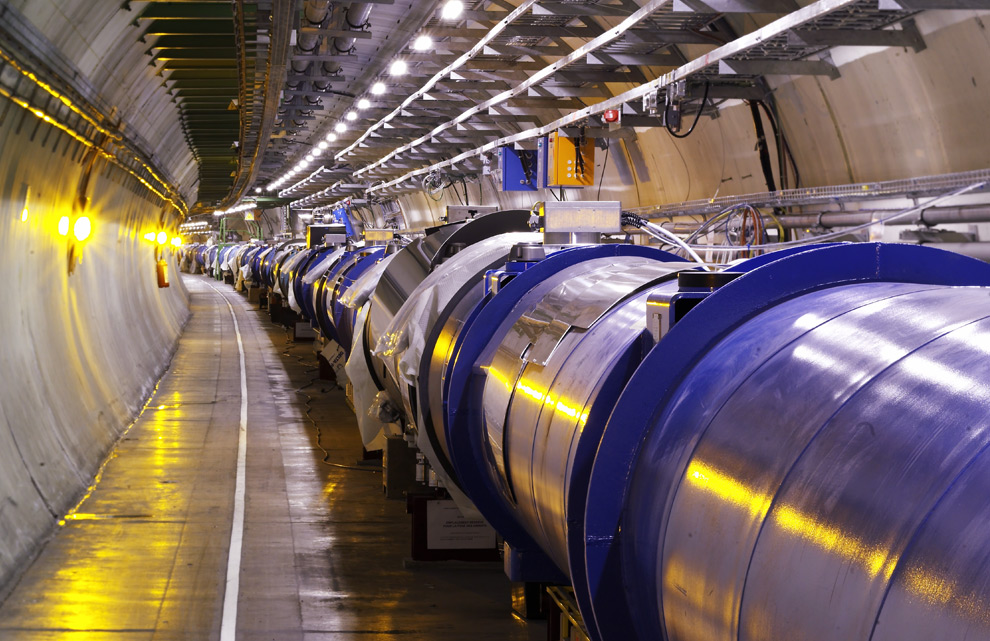 The LHC is nearly ready. I guess the people at CERN will find want they are looking for, because too many researchers have been working too long at the project. They have to find s.th., and because the amount of data is so huge, they will probably find what they expect: something that can be identified as a Higgs boson. But there will be more open questions than answers: if they find the Higgs boson, say with mass 142 GeV, why does it have the mass it has? If this experiment takes already decades to finish and billions of Euros, what about the next? The LHC has a circumference of 27 km and 1600 superconducting magnets weighing over 27 tonnes each, the ATLAS dectector is half as big as the Notre Dame Cathedral in Paris and weighs about 7000 tonnes. To pinpoint the smallest fragments of the universe you have to build the biggest machine in the world.. See this 30 stunning images and other more impressive big pictures. The LHC photo above is from Maxmillion Price, (c) CERN. There are of course a number of YouTube videos, for example the following ones:
Cosmic Variance has a nice summary what the LHC will find here and PhD Comics has a series of comic strips about it (see part 1, part 2, part 3, part 4, part 5). The BBC offers an introduction, and Wired describes the best- and worst case scenarios here. Finally there is a “LHC explained” video for dummies:
7 Sep 2008
 No computer has ever been designed that is aware of what it’s doing, but there is no reason why it should not be possible to build a large distributed system of computers which is aware of it.
Even if we know how to build a plane or a computer, it is nearly impossible for a single person to do it from scratch. It’s an engineering problem, and obviously even experienced engineers need the right building blocks and the right tools to do it. Achieving true AI is similar: even if we know how to do it, it is nearly impossible for a single person to do it right now.
As far as one can tell today, to achieve real AI, you will need to cross a complexity threshold. It is unclear how many servers and datacenters you will need to cross the complexity threshold for a new kind of AI, but the number is probably above 100,000 servers – roughly the number of servers which Microsoft and Google use already today in their datacenter for search purposes.
We have also increasingly complex virtual worlds and MMORPGs which resemble more and more the real world. If we combine both, the power of the datacenter with the virtual worlds, then new forms of AI should be possible. We would need..
* ..the combined processing power of a
large number of huge data centers..
* ..to control an adaptive agent which
lives and is embedded in..
* ..a virtual world which is complex
enough to support AI
see also our wiki page: Beyond AI, the Flickr datacenter photo is from the Flickr user jspaw

